The ancient Greeks figured it out first: a healthy mouth carries a strong mind through everything else. A few thousand years later, the same instinct lives on in a tool that sits on your bathroom counter, unexamined, twice a day. The toothbrush has quietly become one of the most misunderstood instruments in personal care — used by everyone, optimized by few, and rarely designed to match the anatomy it serves.
This is the story of what that instrument can actually do: the geometry hidden in its bristle arrangement, the physics of sonic vibration it delivers, the evolutionary arc from chew stick to sonic symmetry, and the small, decisive details — from the 45-degree angle to the two-minute timer — that separate ritual from result. Consider it the owner’s manual the box never included.

The Ritual We Never Question
Every morning, half-awake, you reach for the same slender handle. The bristles meet enamel in a motion so ingrained it feels reflexive. Yet beneath the foam and mint lies a question few pause to ask: why does a toothbrush look the way it does?
For millennia, the answer was utilitarian—a frayed twig, a boar-hair tuft tied to bamboo, a bone handle strung with horsehair. The 20th century brought nylon, then electricity, then oscillation, then Bluetooth connectivity. But the fundamental geometry remained stubbornly one-sided: a single row of bristles demanding perfect human technique.
Three Sides to Every Tooth
Consider the anatomy. Each tooth presents three surfaces—occlusal, buccal, lingual. The gumline wraps around like a cuff, a hidden reservoir where plaque pools and inflammation begins. A single-sided brush forces you to reposition, re-angle, re-engage for every surface. Miss a spot today, and the same spot goes untouched tomorrow. Weeks become years. Gum disease doesn’t announce itself; it accumulates.
The mathematics are unforgiving. Clinical studies confirm: the average person brushes for 40–45 seconds, not the recommended two minutes. Even diligent brushers struggle to maintain a 45-degree angle along every millimeter of gumline. The Bass technique, the Stillman method, the Charter approach—each demands dexterity and discipline that fatigue erodes.
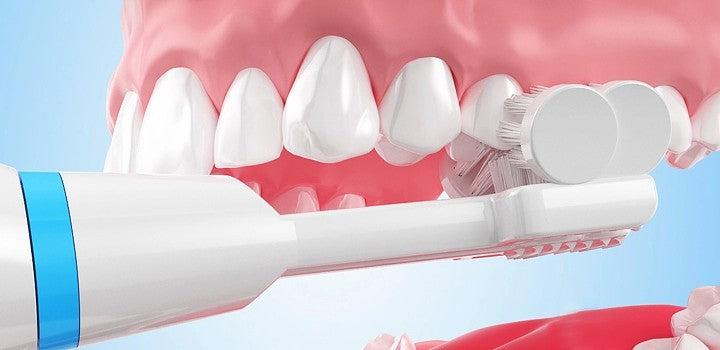
The Geometry of Certainty
Enter a different logic: a brush head that wraps the tooth. Three bristle fields, angled inward, contacting all surfaces simultaneously. The occlusal plane, the cheek side, the tongue side—each meets filaments at the critical 45-degree angle without conscious effort. The guesswork vanishes. The timer counts down two minutes; the sonic vibrations do the work. Forty seconds per arch. Done.
This isn’t speculation. Independent testing shows three-sided sonic heads remove plaque at the gumline more consistently than single-sided counterparts, especially in posterior regions where access is poorest. The design compensates for human variability—hand size, dexterity, attention span.
Brands That Shaped the Conversation
The market offers worthy single-sided sonic options. Philips Sonicare pioneered high-frequency fluid dynamics. Oral-B perfected oscillating-rotating mechanics. Waterpik integrated hydro-flossing. Panasonic brought Japanese precision to the bathroom counter. Each excels—provided the user masters technique.
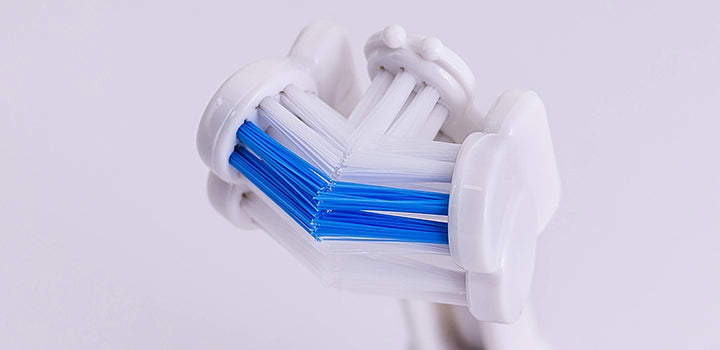
Triple Bristle took a different path. Founded by Dr. Max Babiner, DMD, the brand asked why the tool shouldn’t adapt to the anatomy rather than demanding the anatomy conform to the tool. The patented 3D Max brush head adjusts to tooth contours automatically. Three speeds. Auto-timer. No Bluetooth required.
The Gumline Is the Battlefield
Plaque doesn’t colonize enamel; it colonizes the sulcus—that microscopic moat between tooth and gum. When you bite an apple, the fruit scrubs the visible surfaces. The hidden margin remains untouched. Brushing the crown is cosmetic; brushing the margin is preventive.
Periodontitis begins here. So does halitosis. Calculus forms where the brush never reached. The three-sided design places bristles directly into the sulcus on all surfaces simultaneously. No rolling wrist. No awkward angling behind lower anteriors. The geometry does the thinking.
From Chew Stick to Sonic Symphony
The lineage is humbling. 3500 BCE: Babylonian chew sticks. 15th century: Chinese boar-bristle bamboo. 1780: English horsehair-and-bone Addis brush. 1938: Dr. West’s nylon revolution. 1954: Swiss electric plug-in. 2007: counter-oscillating heads. 2014: French smartphone-connected brushes. Each iteration solved a problem of its era—access, consistency, feedback.
The three-sided sonic head solves the final variable: technique independence. It doesn’t replace good habits; it guarantees them.
The Sound of Clean
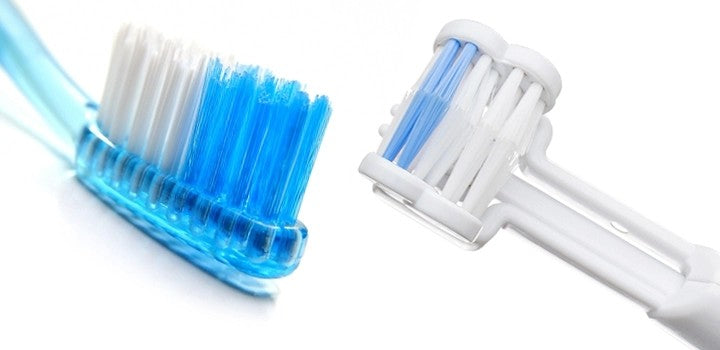
Sonic frequencies—31,000 to 40,000 brush strokes per minute—create fluid shear forces that disrupt biofilm beyond bristle contact. Saliva, toothpaste, and water become cleaning agents in the interproximal spaces. The three-sided architecture channels this fluid dynamics along every surface concurrently. You feel it: a cool, tingling thoroughness that manual brushing rarely achieves.
Forty Seconds That Change Everything
The autotimer pulses at 30-second intervals, guiding quadrant transitions. Two minutes total. Forty seconds per arch. The average person already spends 40–45 seconds brushing—now those seconds are distributed perfectly. No quadrant neglected. No surface skipped. The routine transforms from aspiration to execution.
Designing for the Life You Actually Live
Luxury isn’t marble countertops or gold-plated handles. It’s a tool that works flawlessly when you’re tired, rushed, or distracted. It’s the confidence that your oral health isn’t hostage to your morning mood. The three-sided brush sits on its charging base—minimalist, unobtrusive—ready for the next ritual.

The Clinical Consensus
Dental professionals increasingly recognize: the best brush is the one used correctly every time. Three-sided sonic technology removes the “correctly” variable. Hygienists report reduced bleeding indices and shallower pocket depths in patients who switch. The data aligns with the geometry.
Your Next Two Minutes
Tonight, watch yourself brush. Note the contortions—the wrist rolls, the cheek stretches, the moments you guess. Then imagine placing a head that hugs each tooth, activating, counting down, finishing. The foam rinses away. The gumline is clean. All of it.
As an affiliate publisher, we may earn a commission from qualifying purchases made through links in this article.