There is a particular kind of morning that arrives in late September. The air has changed overnight, the light comes in at a different angle, and the wardrobe that served you faithfully through August suddenly has nothing to say. You stand in front of a full closet and feel, paradoxically, that you own nothing at all.
This is the moment the capsule was invented for. Not as a restriction, not as an aesthetic exercise, but as an answer to a very practical question: what if twenty pieces could replace the hundred that never quite work?

The number itself is not magic. What matters is the logic behind it. A capsule is not a smaller wardrobe; it is a chosen one. Every piece is selected because it can speak to at least three others, and because it will still be worth wearing when the season ends. Once that condition is met, the mathematics becomes generous: twenty interlocking pieces can yield well over a hundred distinct combinations, and suddenly the pressure of “nothing to wear” dissolves into something closer to play.
The Season That Asks You to Choose
Autumn is the most demanding season for a wardrobe and the most rewarding. It is not cold enough to commit to winter, not warm enough to pretend summer lingers. Temperatures swing ten degrees between morning and evening. Rain arrives without warning. A single day may ask for three different outfits, and you are expected to move between them without carrying a suitcase.
This unpredictability is exactly why autumn rewards discipline more than any other season. Summer forgives a random dress. Winter forgives a single heavy coat. Autumn does not forgive a wardrobe that cannot layer, shed, and recombine. The capsule approach is not about deprivation — it is about building a small system flexible enough to handle a season that refuses to hold still.
There is a quieter benefit too. Most people report that dressing takes half the time once the choices are bounded. Fewer decisions, made once and made well, free up the morning. Psychologists have long observed that decision fatigue is real, and a wardrobe that has already made its choices for you is a small but genuine relief.
The Arithmetic of Twenty Pieces
The rule that makes everything work is simple and unforgiving: every item must combine with at least three others in the capsule. Not two. Three. That single constraint is what transforms a collection into a system.

Consider what happens when it is respected. Five tops, four bottoms, three outerwear pieces, two dresses, three pairs of shoes, and three accent pieces form a grid of possibilities in which almost every intersection works. Multiply the layers and the count climbs past a hundred outfits — not theoretical outfits, but ones you would actually leave the house in.
The constraint also does something subtle to your buying habits. When you are standing in a shop, the question stops being “do I like this?” and becomes “does this speak to three things I already own?” That is a much harder question, and it eliminates a remarkable number of mistakes before they happen.
Where Colour Does the Heavy Lifting
Long before individual pieces are chosen, a palette decides whether the capsule will cohere or collapse. The most reliable approach is to fix a small set of colours first and let them guide every purchase that follows.
The first option is a monochrome base — greys, blacks, and whites — with a single saturated accent such as emerald or deep wine. This reads as sharp and deliberate, and it suits anyone drawn to high contrast and structured, office-ready dressing. The accent colour does all the emotional work; everything else stays quiet.
The second is a classic scheme built from beige, brown, white, and navy. It is the palette of understated elegance, endlessly forgiving, and it takes to mustard, terracotta, or deep green as accents without ever losing its composure.
The third might be the most autumnal of all: a warm palette running through every shade of brown, brick, mustard, and cream. It flatters warm undertones beautifully and creates a feeling of comfort even in tailoring.
Whichever direction you take, hold the line at four core colours — one of them neutral, one of them an accent. A palette is only useful if it can say no.
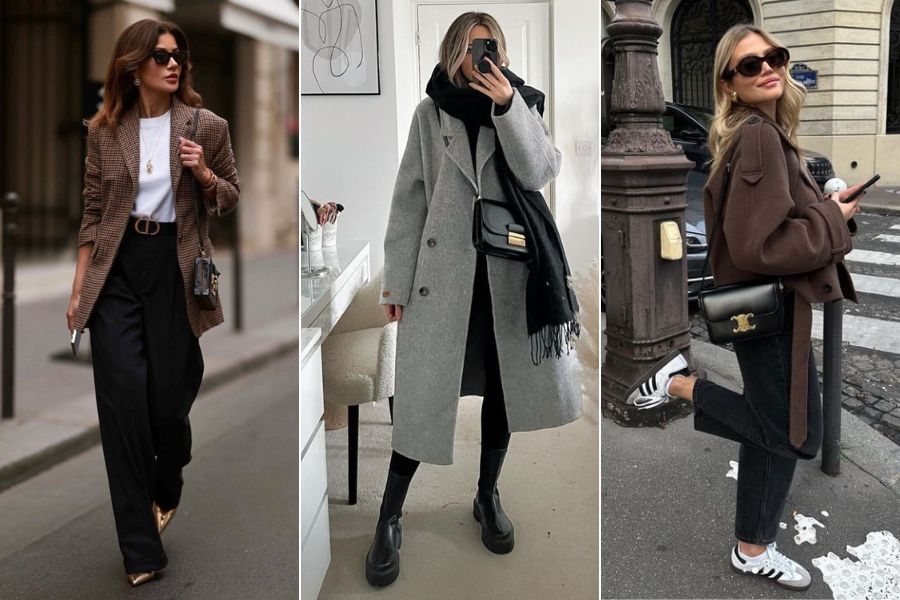
The Upper Half: Five Pieces That Anchor Everything
With the palette fixed, the tops come next — and here the principle is to cover every register from formal to relaxed without duplicating function.
A crisp white shirt is the first purchase. It works alone under a blazer, open over a knit, or buttoned to the collar beneath a coat. A fine knit top in the palette’s main colour is the second: it layers under everything and looks finished on its own. A turtleneck in black or the dominant tone is the third — the piece that makes a coat wearable in genuinely cold weather. A light sweater, neither bulky nor thin, is the fourth, and a cardigan is the fifth, because nothing else moves as gracefully between indoor and outdoor, casual and composed.
Five pieces, five distinct jobs. Between them they can dress almost any bottom in the capsule and any layer above it.
The Lower Half: Four Silhouettes, Endless Ground
Bottoms are where capsules most often fail, usually because people buy five versions of the same trouser. The goal is variety of shape, not variety of colour.
Straight-leg trousers in the palette’s neutral anchor the formal end. A pair of dark, close-cut jeans handles everything casual without looking careless. A knee-length pencil skirt brings a vertical line that pairs with every top in the capsule, and a pleated midi skirt adds movement and softness — the piece that makes a plain knit look considered rather than accidental.
Four silhouettes, one palette. Every top now has somewhere to go.
Outerwear: The Three Layers Between You and the Weather
Outerwear is the visible architecture of an autumn wardrobe, and three pieces cover the entire season.
A trench or light coat in a neutral shade handles the transition weeks when a jacket is too much and nothing is too little. A denim or utility jacket absorbs the casual days and layers neatly under heavier pieces when the temperature drops. A warm cardigan-coat or tailored wool coat carries you into the cold end of the season with dignity.
Three layers, each answering a different temperature band. This is what makes the capsule weatherproof rather than merely stylish — the ability to subtract or add a layer without undressing the whole look.
The Quiet Power of Accessories
A capsule without accessories is a uniform. With them, it is a wardrobe.
Start with the pieces that work every day: a good leather bag, a simple watch, a pair of earrings you never take off. These are the constants. Then add the seasonal accents — a bright scarf, an unusual piece of jewellery, a beret or a structured hat — that change the temperature of an outfit without changing a single garment beneath it.
Belts deserve particular attention because they alter silhouette rather than colour. A thin belt defines a waist under a loose dress; a wide corset-style belt turns an oversized sweater into something closer to a tunic. Bags follow the same logic of function: a structured bag for work, a soft hobo for weekends, a small crossbody for evenings.
Accents are where a twenty-piece capsule stops feeling like twenty pieces.

The Art of Layering
Layering is the skill that makes a small wardrobe behave like a large one, and it follows a formula worth memorising: base layer, middle layer, outer layer. A turtleneck or fine top sits closest to the skin; a shirt or light sweater goes over it; a cardigan, blazer, or jacket completes the construction. Each layer can be removed independently as the day warms, which is precisely what autumn demands.
Proportion is the second half of the craft. A short cardigan over a long shirt, a long jacket over a short skirt — contrast in length reads as intentional and modern. And texture matters as much as colour: smooth silk against chunky knit against dense wool gives an outfit depth that a single fabric can never achieve.
The third element rule is a useful final check. If an outfit has two main pieces, add a third that either unifies or deliberately contrasts — a jacket, a scarf, a belt, an unexpected shoe. That third element is usually what people remember.
Twenty Pieces, One Hundred Outfits
What does the capsule actually look like on a Tuesday?
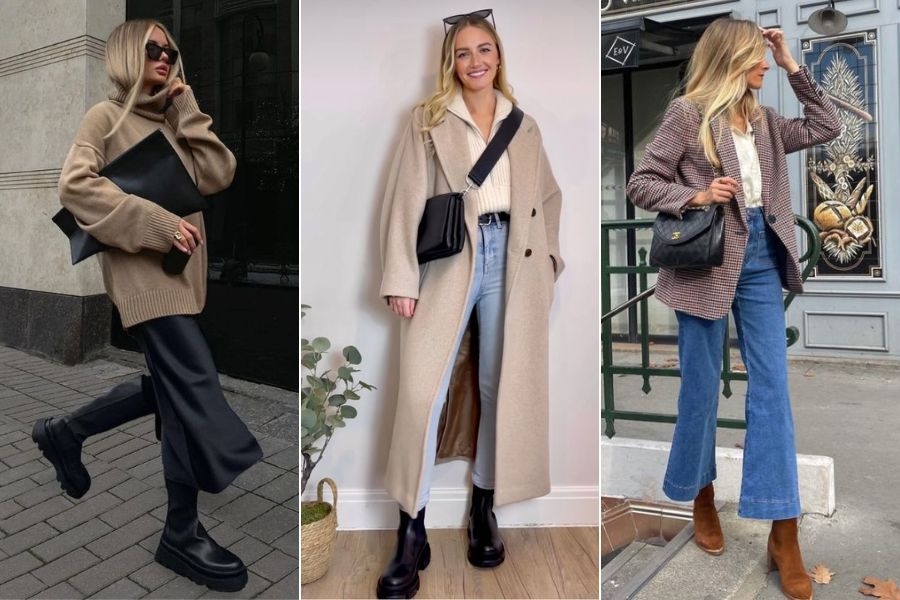
A classic combination might be a trench over narrow dark jeans and a white shirt, finished with a knit hat, a scarf, and a mid-sized bag. A relaxed daytime version trades the trench for a parka and pairs a light grey knit with navy jeans and dark brown boots, with a leather backpack carrying the rest of the day. For an evening, a leather or knit dress under a trench with ankle boots, black gloves, and a small crossbody feels deliberate without effort.
An office day is built on navy trousers, a white shirt, a grey blazer, and black boots, with a structured satchel and a light coat. A city walk swaps tailoring for an oversized knit in autumn tones, jeans, and brown boots, with a scarf and a practical backpack.
Every one of these draws from the same twenty pieces. That is the point: the wardrobe does not change, only the arrangement.
Buying Well: Budget, Timing, Priorities
A capsule is an investment, and like any investment it rewards patience over impulse. The practical approach is to buy in order of how often a piece will be worn: trousers, coat, and shoes first, because they carry the most weight and are the most visible when they fail. Tops and accents can follow gradually.
Timing matters too. The end of a season is when genuinely good basics appear at reasonable prices, provided you stay inside your palette and resist the temptation of a bargain that speaks to nothing you own. A cheap piece that fits the capsule is worth more than an expensive one that does not.
Care, Storage, and the Long Game
A small wardrobe only works if its pieces survive. Good hangers, cedar shoe inserts, and the correct care products for each material extend the life of everything you have bought, and they cost a fraction of replacing it.
Storage deserves the same attention. When everything is visible, combinations present themselves; when half the wardrobe is buried, those pieces effectively stop existing. A periodic review is equally useful — if something has gone unworn for a full season, it probably does not belong to the capsule, and letting it go makes the remaining pieces easier to see and easier to use.
Twenty Pieces Later
The capsule is not really about the number twenty. It is about the shift in thinking that the number forces: from accumulation to intention, from reacting to a season to preparing for it. What changes is not just the wardrobe but the morning. You open the doors, and instead of a wall of almost-choices, you see a small, coherent system that already knows how to dress you.
Autumn rewards that kind of preparation more than any other season. Build the twenty carefully, let the palettes and layers do their work, and the question that started all of this — what do I wear today? — quietly stops being a problem.